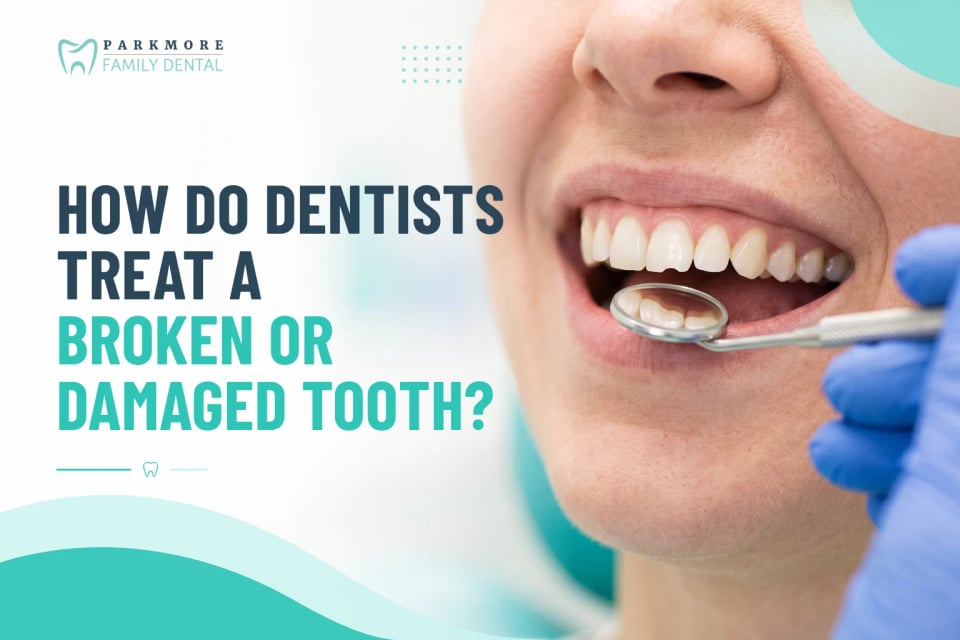
It usually happens at the worst moment. You bite into something hard, take a knock during weekend sport, or run your tongue over a sharp edge that wasn’t there yesterday. Suddenly, you’re wondering how bad it is and what comes next.
Many broken teeth can be repaired, and the sooner you act, the more options you’re likely to have. At Parkmore Family Dental, we regularly treat chipped, cracked, and broken teeth, and how we repair yours depends mainly on how deep the damage goes. This guide covers the first steps to take and the treatments we offer, helping you feel prepared before your appointment.
What Should You Do If You Break a Tooth?
What you do in the first few hours can make a real difference. We recommend having a damaged tooth checked as early as possible, even if it doesn’t hurt, as prompt care can improve the chances of saving it.

- Rinse your mouth gently with warm water to clear away any debris.
- Find any broken pieces and keep them in milk or your own saliva. Bring them to your appointment, as we may be able to bond the fragment back on.
- Hold something cold against your cheek to ease any swelling.
- Keep food away from the broken tooth until it has been assessed.
- Call us on (03) 8592 0298 as soon as possible, even if the pain settles.
If an adult tooth has been knocked out completely, pick it up by the crown (not the root), keep it moist in milk and seek care immediately, ideally within 30 minutes. Call us straight away.
If a baby tooth is knocked out, DO NOT try to put it back in, as this can harm the adult tooth growing underneath. Call us so we can check your child’s mouth and put your mind at ease.
Is a Broken Tooth a Dental Emergency?
It can be. Severe pain, heavy bleeding, a knocked-out adult tooth, or a break that exposes the pink or red centre of the tooth all need urgent attention. We offer emergency dental appointments, and we aim to see urgent cases as soon as we can.
A painless chip may not need urgent care, but we still recommend having it checked soon. Cracks can run deeper than you can see, and only an examination and X-ray can show the full picture. Wondering whether you need urgent dental care? Call us, and our team will help you work out how soon you need to be seen.
Signs Your Tooth Needs Attention Soon
Not every break is obvious. A tooth can seem perfectly fine on the surface while hiding a problem underneath. Arrange a dental appointment if you notice any of these signs:
- Pain when biting or releasing your bite
- Sensitivity to hot or cold that lingers
- A rough or sharp edge rubbing against your tongue
- Swelling or tenderness in the gum nearby
- A tooth that appears darker than the surrounding teeth
The earlier the problem is noticed, the better the chance of saving the tooth with a simpler repair.
Can a Broken Tooth Heal Itself?
No. Unlike a broken bone, tooth enamel can’t grow back. Even if the pain eases, bacteria and food can build up in the damaged area, gradually weakening the tooth. Over time, an untreated chip may deepen and expose the tooth to infection, which is why we recommend repairing a break rather than waiting to see if it settles.
How We Treat a Broken or Damaged Tooth
A tooth has three main layers. The outer layer is enamel, a tough shell with no nerves. Just beneath is the dentine, which is softer and more likely to feel twinges from hot or cold. Right at the core sits the pulp, where the tooth’s nerve and blood vessels are. The deeper a break reaches, the more involved the repair tends to be.

At your appointment, we will examine the tooth and take digital X-rays to see how far the damage goes. We’ll show you what we find, explain each suitable option and its cost, and answer every question you have before any treatment begins. There is no pressure to decide on the spot.
Damage to the Enamel Only: Smoothing or Bonding
Small chips that affect only the outer layer are often the simplest to fix. In some cases, we just need to smooth the rough edge. Otherwise, we may recommend composite bonding, where a tooth-coloured resin is shaped over the chipped area and hardened with a special light. In many cases, this can be completed in a single appointment.
Damage Exposing the Dentine: Fillings, Onlays or Crowns
Once a break exposes the dentine, the tooth may feel sensitive to hot, cold or sweet foods. For a smaller break, a tooth-coloured filling may be all you need. If a larger section is missing, especially on a back tooth that handles heavy chewing, we may recommend an onlay or a crown. A crown fits over the whole tooth like a protective cap, helping to hold weakened walls together, and we match its colour and shape as closely as possible to your natural teeth. Learn more about our restorative dentistry options.
If it’s a front tooth that’s chipped, a veneer may be another option. This thin, tooth-coloured shell is bonded over the visible surface, but it usually involves removing a small amount of enamel first, which can’t be reversed. We can explain whether it suits your situation as part of our cosmetic dentistry options.
Damage Reaching the Pulp: Root Canal Treatment

If the break goes deep enough to expose the nerve, or the pulp becomes infected, we may recommend root canal treatment. It involves removing the inflamed or infected pulp, cleaning the inside of the tooth, and sealing it. A treated tooth can be more brittle, so we will usually recommend a crown for added protection. If your case is more complex, we’ll discuss referral to a registered specialist.
When a Tooth Can’t Be Saved
Some breaks split the tooth vertically or extend well below the gum line. If there isn’t enough healthy structure left to support a repair, removal may be the most suitable option. We will talk you through the ways we can replace the tooth, including dental implants, bridges and dentures.
Does Fixing a Broken Tooth Hurt?
Most repairs are carried out under local anaesthetic, so the area stays numb during treatment. You may feel some pressure during the procedure and mild tenderness for a few days afterwards. We will explain what’s normal and how to care for the tooth while it settles.
If you feel nervous about dental visits, just let us know when you book. Our guide on how to overcome dental anxiety explains how our team can help make your visit feel calmer and more comfortable.
How Can You Prevent Another Broken Tooth?
Once your tooth is repaired, a few simple habits can help lower the risk of another break:
- Wear a mouthguard for sport: We can make a custom-fitted mouthguard shaped to your teeth, which generally fits better than an over-the-counter guard.
- Ask about a night guard if you grind your teeth: Grinding wears teeth down over time and can make them more likely to crack.
- Avoid chewing ice, hard lollies or pens, and resist using your teeth to open packets or bottles.
- Keep up regular check-ups: At your check-up and clean, we can often spot small cracks or worn fillings before they break, and will recommend how often you need a visit.
Chipped or Broken a Tooth? Our Keysborough Team Can Help
Accidents rarely happen at a convenient time, which is why we offer Saturday and Sunday appointments, as well as evening appointments on Mondays, Tuesdays and Thursdays. When you visit, we’ll assess the damage, show you what we find, and walk you through your repair options before any treatment begins. Eligible children may be able to access benefits for fillings and extractions through the Child Dental Benefits Schedule (CDBS).
Book Your Dentist Appointment Today, or call us on (03) 8592 0298 if you’re unsure whether your tooth needs urgent care. Looking for a dentist near you? We’re here for the whole family.